via Legendary seatmaker Recaro rescued from financial collapse
Recaro Automotive, the legendary seat manufacturer known for its premium products in performance and luxury vehicles, has been rescued from financial ruin.
After filing for bankruptcy in July, the German company has found a lifeline in Proma Group, an Italian parts supplier specializing in automotive components. The deal secures Recaro’s operations and paves the way for a relaunch in January 2025.
Proma Group’s investment marks a turning point for Recaro. The agreement ensures that production will resume next year, with OEM seat manufacturing moving from Germany to Italy. Aftermarket seat availability is also expected to restart in January, a promising sign for customers and automakers reliant on Recaro’s reputation for quality.
To maintain continuity, Proma will retain several key Recaro employees, particularly in the sales and technology departments, who will remain based in Stuttgart, Germany. This approach aims to preserve Recaro’s expertise and customer relationships during the transition.
While major production shifts are planned for Europe, Recaro’s operations in North America and Japan will continue uninterrupted, part of Proma Group’s effort to create a smooth transition for Recaro as the company undergoes the switch in ownership.
2024 Ford Mustang Dark Horse Recaro seats
“Our investment in RECARO Automotive will strengthen our ability to deliver a premium seating product, while embracing the most cutting-edge innovations in the automotive sector,” said Proma Group CEO Luca Pino. “The RECARO name is renowned throughout the world as a benchmark of German industrial technology, and Proma Group, a symbol of Italian manufacturing excellence, is excited about the future and the quality that will be expressed in the automotive market thanks to the union of two first-class companies.”
Proma, which employs over 5,000 people across 25 factories worldwide, manufactures various automotive components, including seat structures and body assemblies.
Recaro’s financial struggles made headlines earlier this year when the company was linked to production delays for Ineos Automotive’s Grenadier SUV and Quartermaster pickup. Supply issues with Recaro seats temporarily halted manufacturing, underscoring the challenges the seatmaker faced in fulfilling orders. Production at Ineos is expected to resume alongside Recaro’s relaunch.
This tumultuous period isn’t unique to Recaro. Other automotive icons like BBS Wheels and Hoonigan have also faced financial difficulties in 2024, reflecting broader instability within the industry.
Proma’s investment secures the future of Recaro, one of the world’s oldest seat makers. As the brand prepares for its European relaunch, enthusiasts and automakers alike can anticipate the return of Recaro’s seats, which have become an iconic part of any performance-oriented car.
It seems these days that new cars are more expensive than they have ever been. As buyers search for frugal options that offer space, practicality, and solid resale value in exchange for a slightly higher up-front cost, does a $32,200 MINI Cooper really make any sense?
2025 MINI Cooper S
MINI
Comparably priced vehicles offer so much more
It's important to keep in mind that the 2025 MINI Cooper S's $32,200 MSRP is the base price for the model. If you tick enough boxes for optional extras, that price tag can get up to almost $40,000, which is not exactly a drop in the bucket for a sub-compact, two-door hatchback. Are larger new cars really that much more expensive?
The answer is: no, larger cars are not really that much more expensive. In fact, many are even cheaper. To offer some examples, a 2025 Toyota RAV4 Hybrid LE starts at $31,900, a 2024 Ford Ranger XL starts at $32,820, and a 2024 Volkswagen Golf GTI starts at $31,965. Expect the mildly refreshed, 2025 Volkswagen GTI to start at around $34,000.
That means for about the same money as the Cooper S, you could instead have a hybrid version of America's best-selling crossover, a mid-size pickup truck, or a hot hatch with better performance, more interior and cargo space, higher resale value, and better performance figures. So who would buy the MINI?
2025 MINI Cooper S
MINI
Does the Cooper S's performance justify its price tag?
The 2025 MINI Cooper S has improved upon its predecessor's powertrain with a turbocharged 2.0L straight-four that produces 201 horsepower and 221 lb-ft of torque. Unfortunately the stick shift option is no more, and a seven-speed dual-clutch gearbox has become the standalone transmission option, and power is sent exclusively to the front wheels. With a curb weight of 3,014 pounds, the Cooper S should be a riot on twistier roads.
That all sounds fine and dandy until you compare the Cooper S with the Volkswagen GTI – the king of the hot hatch segment. For about the same price as the Cooper S, the GTI offers far more interior space, cargo space, and generally better resale value. The GTI also uses a turbocharged 2.0L straight-four mated to a seven-speed dual-clutch gearbox and front-wheel drive, but its power output is 241 horsepower and 273 lb-ft of torque. Weighing in at 3,188 pounds, it is heavier than the MINI, but not by much.
2025 MINI Cooper S
MINI
If we look at other comparable sporty cars around the Cooper S's price point, the story remains the same. The 2024 Subaru WRX has a starting price of $32,735, and is powered by a turbocharged 2.4L flat-four producing 271 horsepower and 258 lb-ft of torque. It's slightly heavier than the other two, with a curb weight of 3,329 pounds, but the trade-off is its standard symmetrical all-wheel drive system. The WRX can also be had with a six-speed manual transmission, which most of its buyers still opt for.
If competitors offer greater performance value for the money when compared to the 2025 MINI Cooper S, then its price tag can't be justified by its sportiness. It's not as if MINI has a reputation for offering a more reliable product than VW and Subaru either, and in terms of depreciation, the WRX has the best resale value of the entire Subaru lineup. So where is the Cooper S's value being hidden?
2025 MINI Cooper S
MINI
Does the Cooper S offer an elevated, premium feel compared to other options at its price point?
The aesthetics of the 2025 MINI Cooper S's interior are admittedly clean, but "premium" doesn't accurately describe it, even if it is a BMW sub-brand. Perhaps our very own Nathan Adlen described it best when he referred to the interior as "bland". A gauge cluster is absent above the steering wheel, and it seems that all of the necessary driver information has been homogenized into the extremely imposing, circular infotainment screen tacked onto the centre of the dash as if it were an afterthought.
If a premium feel is what you're looking for at this price point, the 2025 Audi A3 starts at $38,200 – about the same price as a reasonably well-optioned Cooper S. Packing a turbocharged 2.0L straight-four that produces 201 horsepower and 236lb-ft of torque, you wouldn't be sacrificing performance either – not to mention the added perks of having four doors and usable rear seats. So, then, the answer is no – the 2025 MINI Cooper S does not offer an elevated, more premium feel than comparably priced vehicles.
2025 MINI Cooper S
MINI
With the 2025 MINI Cooper S, you're paying for its theatrics
The only element of the 2025 MINI Cooper S that outweighs any of its price-tag competitors is its road presence. The Cooper S makes a statement wherever it goes, with unique LED pixel tail lights that evoke the Union Jack, contrasting roof paint options, imposing circular LED headlights, and iconic MINI Cooper proportions.
It seems that MINI is banking on the effectiveness of its brand pedigree and the iconic style of the Cooper to justify its hefty price tag. If style is your priority, then there aren't many new cars out there that match the new Cooper S's road presence and ability to grab attention for the money. However, if you're a realist, and understand that a brand new, $32,200 car should offer more than just a fashion statement, the new Cooper S seems a bit out of touch.
Is the 2025 MINI Cooper S something you could justify spending over $32,200 on? Are you a fan of its cutesy charm or do you find the gimmicks useless and offensive? Let us know how you feel in the comments – we love to hear your thoughts!
Honda recalls 205,760 SUVs due to increased fire riskHonda is recalling more than 200,000 crossover SUVs because fuel-filler neck components may separate, allowing fuel to leak and potentially cause fires. The recall includes 2023-2024 Honda Passport two-row mid-size SUVs and 2023-2025 Honda Pilot three-row mid-size SUVs. Some of these vehicles may have an incomplete connection between the...
The 2026 Cadillac LYRIQ-V will officially launch in 2025 as the brand's first electric V-Series car.
The LYRIQ-V will not be exclusive to the North American market, as both left-hand drive and right-hand drive versions will be built. This means Oceanic markets like Australia and New Zealand can expect to see these electric powerhouses on their roads soon, too. Official figures have yet to be released, but the LYRIQ-V is expected to offer some serious performance as expected from a V-Series model.
2026 Cadillac LYRIQ-V
Cadillac
The LYRIQ-V gets racing-inspired aerodynamic enhancements
The 2026 LYRIQ-V adds to already-sharp looks with subtle aerodynamic enhancements, such as the roof-mounted spoiler that resembles the shape of the Cadillac V-Series.R race car's massive wing. The LYRIQ-V also receives a slightly more aggressive body kit with lower, painted side skirts and edgier bumpers.
Other than its subtle aesthetic enhancements, the LYRIQ-V doesn't look all that different from the standard LYRIQ, and that's not a bad thing. The LYRIQ genuinely might be one of the most attractive EVs out there in terms of design – seamlessly blending the traditional understated Cadillac style with a contemporary flair. It's a solid interpretation of what a modern, electric Cadillac should look like and its road presence punches well above its price tag.
2026 Cadillac LYRIQ-V Interior
Cadillac
Official performance figures have not been announced, but expect the LYRIQ-V to be quick
Cadillac has yet to release official power figures for the 2026 LYRIQ-V, but with standard all-wheel drive, an anticipated horsepower figure well above the 600 mark, and instantaneous acceleration, it will likely be Cadillac's quickest vehicle to 60 mph upon its release.
Notable rivals will include the Tesla Model X and Rivian R1S, but we are still unsure whether the LYRIQ-V will be the highest-performance version of the LYRIQ. It's possible that a LYRIQ-V Blackwing could eventually arrive to compete with the 1,000+ horsepower Tesla Model X Plaid and Rivian R1S Quad.
The 2025 Cadillac LYRIQ is currently available with either a standard, 340 horsepower rear-drive motor or an optional, 500 horsepower dual-motor all-wheel drive setup. The LYRIQ-V will see a significant power bump over its less expensive siblings, but it will be interesting to see what enhancements are made underneath to improve handling and stopping power. The current LYRIQ AWD has a base curb weight of 5,789 pounds, so the V-Series must find a clever way to manage the substantial mass while cornering and under braking.
2026 Cadillac LYRIQ-V Interior
Cadillac
The LYRIQ-V marks Cadillac's successful integration of EVs into their lineup
Cadillac's first attempts at electrification were not well-received, nor very profitable. In 2008, a hybrid version of the Escalade was released, but it still retained the 6.0L V8 and essentially added massive up-front costs without proportional savings on fuel and maintenance.
For the 2014 model year, the ELR debuted, offering a plug-in hybrid coupe that shared most of its underpinnings with the Chevrolet Volt. Thanks to its enormous price tag and lack of practicality, it was a relative sales disaster.
Fast forward to 2024, and General Motors' electrification trial-by-fire has paid off. Through all their initial failure, GM's automakers have figured out how to produce an electrified vehicle that people actually want to purchase.
Cadillac sold 9,155 LYRIQs in 2023 and expects to have sold 20,314 in 2024 by year-end. The existence of a LYRIQ-V is proof that the integration of EVs in Cadillac's lineup has paid off, which has allowed the brand to produce a greater diversity of models and variants that employ the GM Ultium platform technology, like the all-new Vistiq, Escalade IQ, and the LYRIQ-V.
2026 Cadillac LYRIQ-V
Cadillac
Are EVs helping Cadillac regain its premium reputation?
Unlike other American premium brands, such as Lincoln and Chrysler, Cadillac has been successful in maintaining a desirable reputation for producing high-quality products with surprisingly capable driving dynamics.
As Cadillac continues to improve and expand on its successful EV lineup, its overall reputation is following suit. It also proves to buyers that Cadillac has remembered how to make a relevant, fresh, and top-tier product, despite the brand's malaise era of non-engaging, low-quality products during the 1980s and 90s.
Do you feel that Cadillac's contemporary lineup is a refreshing coexistence of high-quality EV crossovers and engaging high-performance super sedans, or do you believe that Cadillac is still no match for its European rivals? Let us know in the comments, we love to hear from you!
via Jaguar reveals its future with polarizing Type 00
Following an advertisement that elicited derision, snarky videos, and lots of commentary, Jaguar Land Rover unveiled its Jaguar Type 00 (or Type Zero Zero) concept Monday in Miami, heralding a momentous start to Miami Art Week.
“This is a really important step for us is we need to move beyond being a heritage brand to a brand with heritage," said Rawdon Glover, Managing Director, Jaguar to journalists during a media briefing on Monday. “Our job as the custodians of the brand is to make sure that Jaguar has relevance, desirability, and sustainability for the next 90 years of its history.”
Jaguar Type 00 Front End
Jaguar
Jaguar chose the name of its new concept car not only as an homage to the 1961 Jaguar E-Type but also to acknowledge the Jaguar brand’s total reset, relaunching as a zero-emission vehicle.
“In terms of in terms of what's happening in the industry and all the changes are coming, we believe that now for Jaguar is the time for a really bold step in terms of what we need to do next," said Glover.
The concept comes as Jaguar has axed nearly every model in its line-up, including the F-Type sports car, XE and XF sedans, XF wagon, E-Pace SUV, and the I-Pace EV. Only the F-Pace remains in production ahead of the introduction of a battery-electric four-door Jaguar GT in late 2025.
The Type 00's captivating looks are unlike anything Jaguar has done before
In an effort to “Copy Nothing,” the concept retains the basic parameters that have always defined Jaguars, namely a long hood, graceful roofline sweeping rearward with a fastback rear, and a proper stance thanks to its large 23-inch alloy wheels. Interestingly, the concept uses glass on its roof, but not on the rear tailgate.
It also wears a distinctive new face. With lighting placed in the corners to emphasize its width, it’s clearly upright and boasts Jaguar’s new fashion-forward logo at its center using a custom typeface named Jaguar Exuberance. Air intakes remain hidden unless needed, at which point they open to let the car breathe.
Jaguar Type 00 Fender
Jaguar
On the side of the car, a hand-finished brass ingot is etched with the Jaguar leaping cat silhouette. The ingots cover the rear-facing cameras, a necessity given its lack of a rear window. And, of course, it’s fitted with butterfly doors, because any concept car worth its salt has them, even if they’re far less convenient to use than traditionally-hinged doors.
The opening door on the front fender dubbed a "Prism Case" houses a "totem". Each totem is made of either brass, travertine, or alabaster and owners can reportedly place it inside the center console to change the cabin lighting and graphics on the dashboard's digital displays. Each totem also plays a unique sound and releases scents inside the cabin.
Jaguar Type 00 Colors
Jaguar
The concepts are finished in Miami Pink and London Blue, the colors were chosen to represent the brand’s heritage as well as acknowledge where its global relaunch was held.
Throughout the car, both inside and out, Jaguar uses parallel lines as design elements. The company refers to them as the "strikethrough", and their presence across the car is one of the concept’s key design signatures. Aside from the leaper engraved on an ingot on each side of the car, there aren’t any heritage design cues. None.
Jaguar Type 00 Cameras
Jaguar
A new design direction meant to elevate Jaguar
Jaguar has dubbed the new look “Exuberant Modernism.”
"It has an unmistakable presence," said Gerry McGovern OBE, Chief Creative Officer for Jaguar Land Rover. "It is our first physical manifestation and the foundation stone for a new family of Jaguars that will look unlike anything you’ve ever seen."
Jaguar Type 00 Badge
Jaguar
The concept is built using the brand’s new Jaguar Electrical Architecture. This allowed the company to engineer and design the Type 00 from scratch, without constricting design with the onus of carrying over components from existing models. The company’s stated aim is to make vehicles that are unmistakably Jaguars, ones that stand out for their stunning design in a sea of SUV and sedan monotony – something the brand hasn’t always adhered to with recent products.
Notably, the automaker didn’t reveal any of the Type 00’s specifications, except that engineers expect the car to have 430 miles of range on a single charge while gaining 200 miles of range in 15 minutes using a DC Fast Charger.
Jaguar Type 00 Wheels
Jaguar
The inside story
Inside, a 10.5-foot, hand-finished brass spine divides the instrument panel, which is accented by two additional brass lines that mirror the ones used on the exterior’s brass ingots as well as on the vehicle’s rear elevation. Travertine stone slabs support the central spine and floating seats, which are covered in a wool blend. That same wool blend is also used for the sound bar and flooring.
“(The) Type 00 embraces authentic, unexpected materials and captivating color,” said Mary Crisp, Jaguar's Chief Materiality Designer. “We have three key materials – brass, travertine stone, and textiles – and the way we use these materials represents bold pieces of art and creates a unique atmosphere.”
Jaguar says the plethora of displays are hidden in the dashboard and can glide out at the push of a button. When the screens are put away, a thin display across the base of the windshield shows key information.
Executives also insist that they are following company founder, Sir William Lyons, who believed that Jaguar should be a ‘copy of nothing.’
Be that as it may, the company is copying battery electric manufacturers in opening brand-exclusive Jaguar brand stores. The first is expected to open in Paris' Golden Triangle. Located in the 8th arrondissement, it is the epicenter of haute couture, grand hotels, and Michelin-starred restaurants. Clearly, it’s an effort to push the brand into the upper echelons of luxury retailers. This gives some indication of the new model’s price tag when the production car is revealed later next year before going on sale in 2026.
Jaguar Type 00 Side
Jaguar
Final thoughts
Jaguar’s provocative new ad had everyone talking, something the Type 00 will continue as the automaker seeks to be on more luxury car buyer’s consideration list.
But its relaunch as an EV brand comes as EV sales hit a historic high of 570,000 units in the first half of 2024, roughly a 6% increase over the same time period last year. Worldwide, sales were up 22% during the same period. So, Jaguar is entering the EV market at an opportune time while re-embracing the qualities that have long drawn buyers to the brand. For Jaguar, this means modern exuberant design, bold use of color, and a fresh aesthetic unlike anything else.
Jaguar Type 00 Rear
Jaguar
Much like Maserati, Jaguar is stepping away from volume luxury production, while repositioning higher in the market. This could mean fewer models, just as it did prior to 1999.
“I have no doubt it will shock, it will surprise and it will polarize,” said Gerry McGovern OBE, Chief Creative Officer for Jaguar Land Rover. “But what it does is speak volumes for our desire to return the Jaguar brand to the values that once made it so loved.”
President-elect Donald Trump’s plan to impose a 25% tariff on imports from Canada and Mexico has sent shockwaves through the auto industry. Automotive manufacturing facilities across the United States depend heavily on cross-border manufacturing and parts. If implemented, the tariff could turn into a financial crisis for automakers and parts suppliers alike.
Patrick Anderson, CEO of Michigan consulting firm Anderson Economic Group, underscored the risk: “There is probably not a single assembly plant in Michigan, Ohio, Illinois, and Texas that would not immediately be affected by a 25% tariff.”
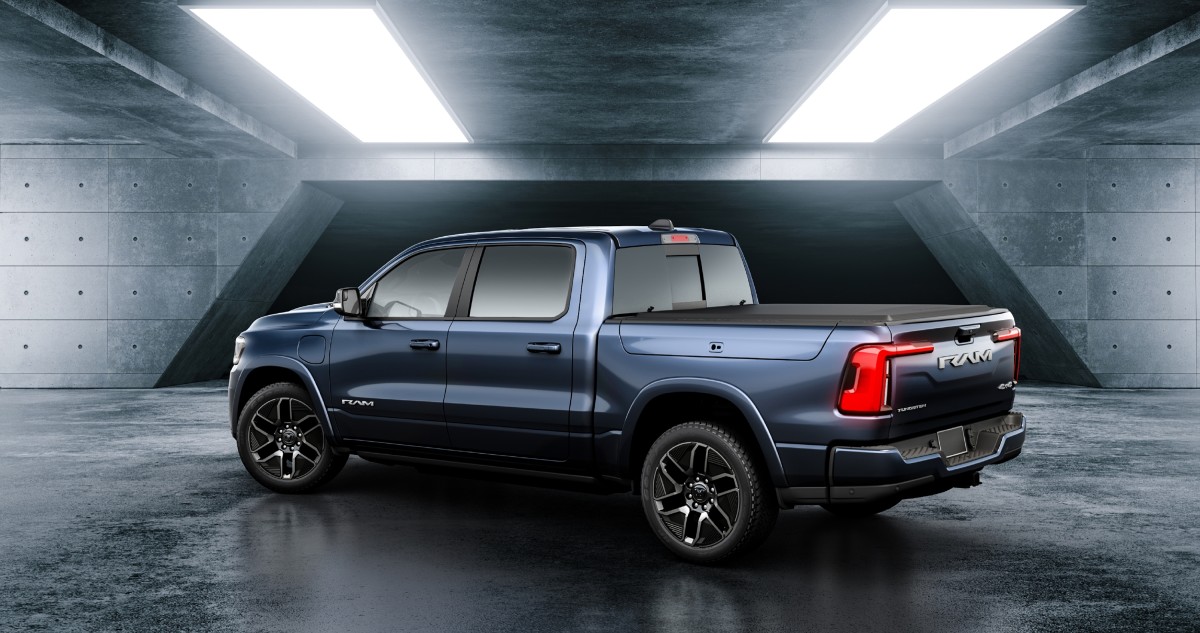
Popular vehicles like the Ram pickup, Chrysler Pacifica, Chevrolet Silverado, and Ford Maverick—produced in Mexico or Canada—would see their prices skyrocket. Such increases could dent sales, lead to layoffs, and contribute to inflation, affecting more than just the auto sector.
The proposed tariffs come at a precarious time for the industry. Automakers are grappling with sagging consumer demand, an EV transition, and rising competition from Chinese brands like BYD.
For example, Stellantis, which owns Jeep and other brands, reported a 27% sales drop in the third quarter of 2024 compared to the previous year. Even traditionally profitable luxury brands like BMW and Mercedes-Benz, which also produce some of their vehicles in Mexico, are reporting slimmer margins.
Layoffs are also mounting. Nissan recently announced plans to cut 9,000 jobs globally, with factories in Mexico and the U.S. feeling the strain. Volkswagen, which produces vehicles in Mexico and Tennessee, is reportedly considering closing some European factories due to falling demand.
Ripple effects on supply chains
The integration of the U.S. auto industry with Canada and Mexico is the foundation of its operations. Mexican and Canadian factories source parts from American suppliers, and those parts flow back and forth across borders seamlessly.
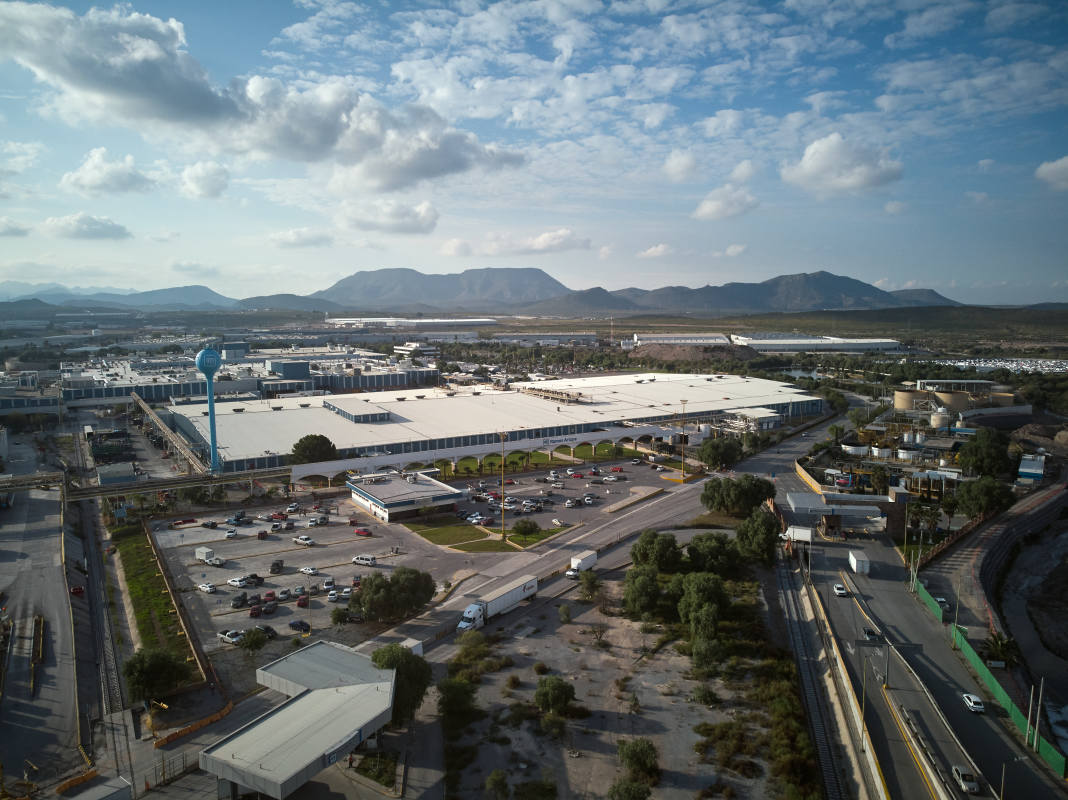
The General Motors Ramos Arizpe facility in Ramos Arizpe, Coahuila, Mexico, on Monday, Oct. 7, 2024.
Even brief disruptions can cause major headaches. In 2022, protests blocking the Windsor-Detroit bridge forced automakers like Toyota, Ford, and Stellantis to halt U.S. assembly lines due to parts shortages.
“Southern Ontario is closer to Detroit auto plants than the supply plants in Indiana, Ohio and Kansas are,” said Erik Gordon, a professor at the University of Michigan. A tariff could disrupt this delicate supply chain, akin to New York City imposing a tax on food and fuel imported from New Jersey, he noted.
Economic and geopolitical concerns
Trump has justified the tariff proposal as a measure to address illegal immigration and drug trafficking from Mexico and spur investment in domestic manufacturing. However, experts warn that such tariffs could backfire economically and politically.
Job losses in Mexico’s auto sector—where over one million people work—could trigger economic instability and even increase migration to the U.S. Analysts also warn that these policies could push Mexico closer to China. Chinese automakers like BYD and Geely are already building a presence in Mexico, and a prolonged tariff standoff could accelerate this trend.
“As the economy goes, there goes prosperity,” said Anna Nagurney, a professor specializing in supply chains. “It can have spillover effects.”
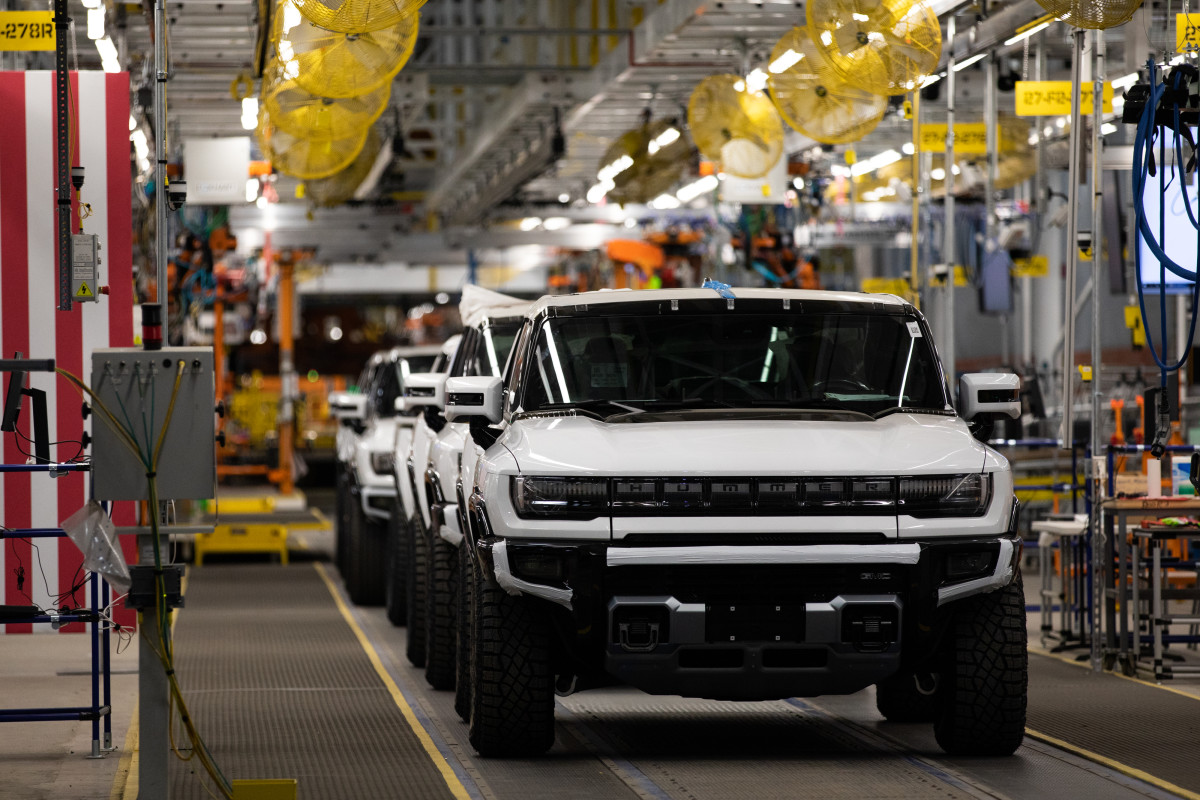
GMC Hummer electric vehicles on the production line at General Motors' Factory ZERO all-electric vehicle assembly plant in Detroit, Michigan, U.S., on Wednesday, Nov. 17, 2021. Photographer: Emily Elconin/Bloomberg via Getty Images
The auto industry is already navigating significant disruption. Legacy automakers like General Motors and Ford have poured billions into EV production and battery manufacturing, buoyed by Biden-era subsidies. Trump’s promise to eliminate these subsidies would further complicate their transformation efforts.
“The auto industry is in the process of a transformation that is the biggest tech upgrade in history,” said Dimitry Anastakis, a University of Toronto history professor. “They are looking for as much stability as possible as they navigate this disruptive landscape. To throw a spanner in the works is not helpful.”
Wall Street and automakers react negatively to the news
The financial markets are already reflecting jitters over Trump’s tariff threat. General Motors’ stock dropped 9% after the news, while Stellantis fell 6% and Ford slipped nearly 3%.
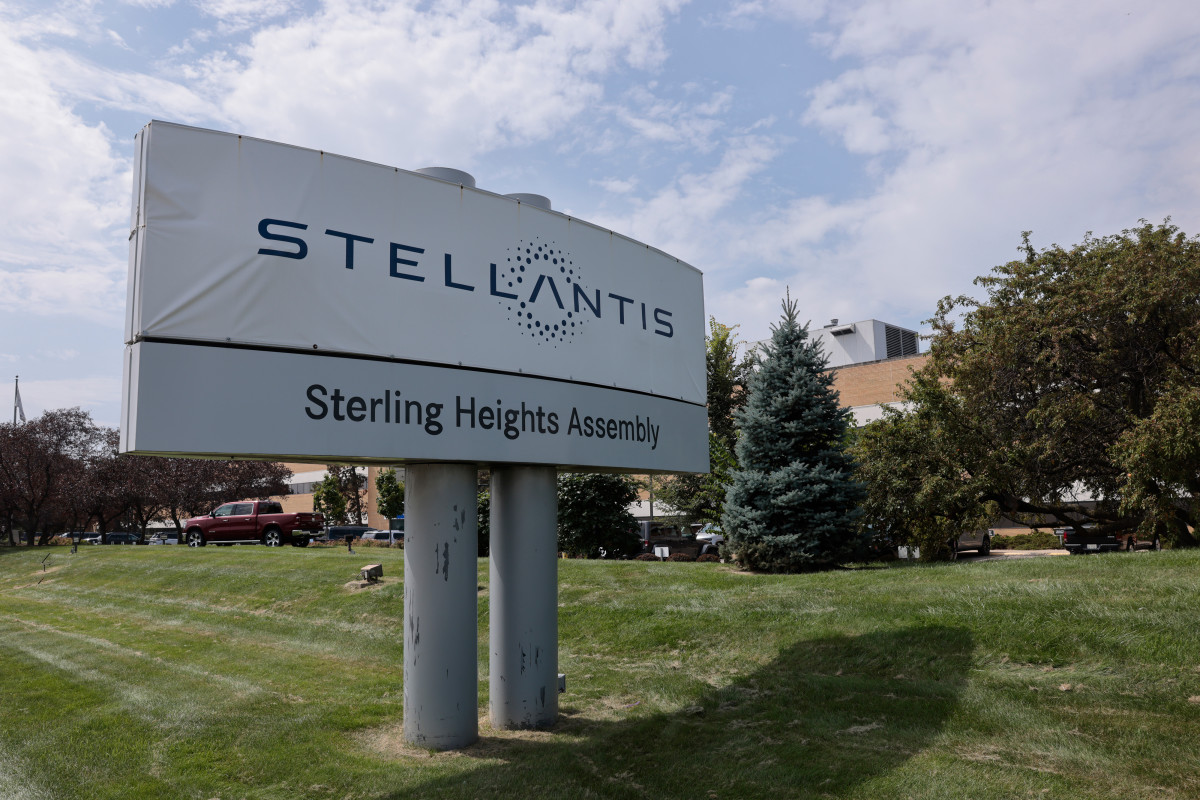
The Stellantis Sterling Heights Assembly Plant in Sterling Heights, Michigan, US, on Friday, Aug. 23, 2024.
Ford signaled that its stock price was less affected by the news due to its manufacturing concentration in the U.S. “Ford is the most committed to building in America among the major automakers.” Meanwhile, BMW emphasized the importance of free trade for global growth and employment, though it refrained from commenting directly on the tariff threat.
There is still hope for a negotiated solution
Some experts speculate that the tariff proposal might be more of a bargaining tactic than a firm policy. By raising the stakes, Trump could push Canada and Mexico to offer concessions even before negotiations formally begin.
“People in China and Canada are thinking about concessions they could make before there is even anything on the table,” said Richard Baldwin, an economics professor at the International Institute for Management Development in Switzerland.
However, with automakers already stretched thin, the mere threat of tariffs adds another layer of uncertainty to an industry undergoing historic change. Whether Trump’s strategy pays off or deepens the auto sector’s woes remains to be seen.
Elon Musk embraces Republican presidential nominee, former President Donald Trump during a campaign rally at the Butler Farm Show fairgrounds on October 05, 2024, in Butler, Pennsylvania. (Photo by Anna Moneymaker/Getty Images)
Trump’s tariff proposal represents a gamble for the auto industry. While it could bring jobs to U.S. soil, the immediate fallout—higher car prices, job losses, and supply chain chaos—may outweigh the long-term benefits. As the industry braces for impact, automakers must prepare for a world where cross-border collaboration is no longer guaranteed.